Charcuterie board cost is easy to underestimate because the product is judged by abundance. A few extra ounces of cheese, heavy cured meat folds, and a premium box can turn a beautiful board into a weak-margin item.
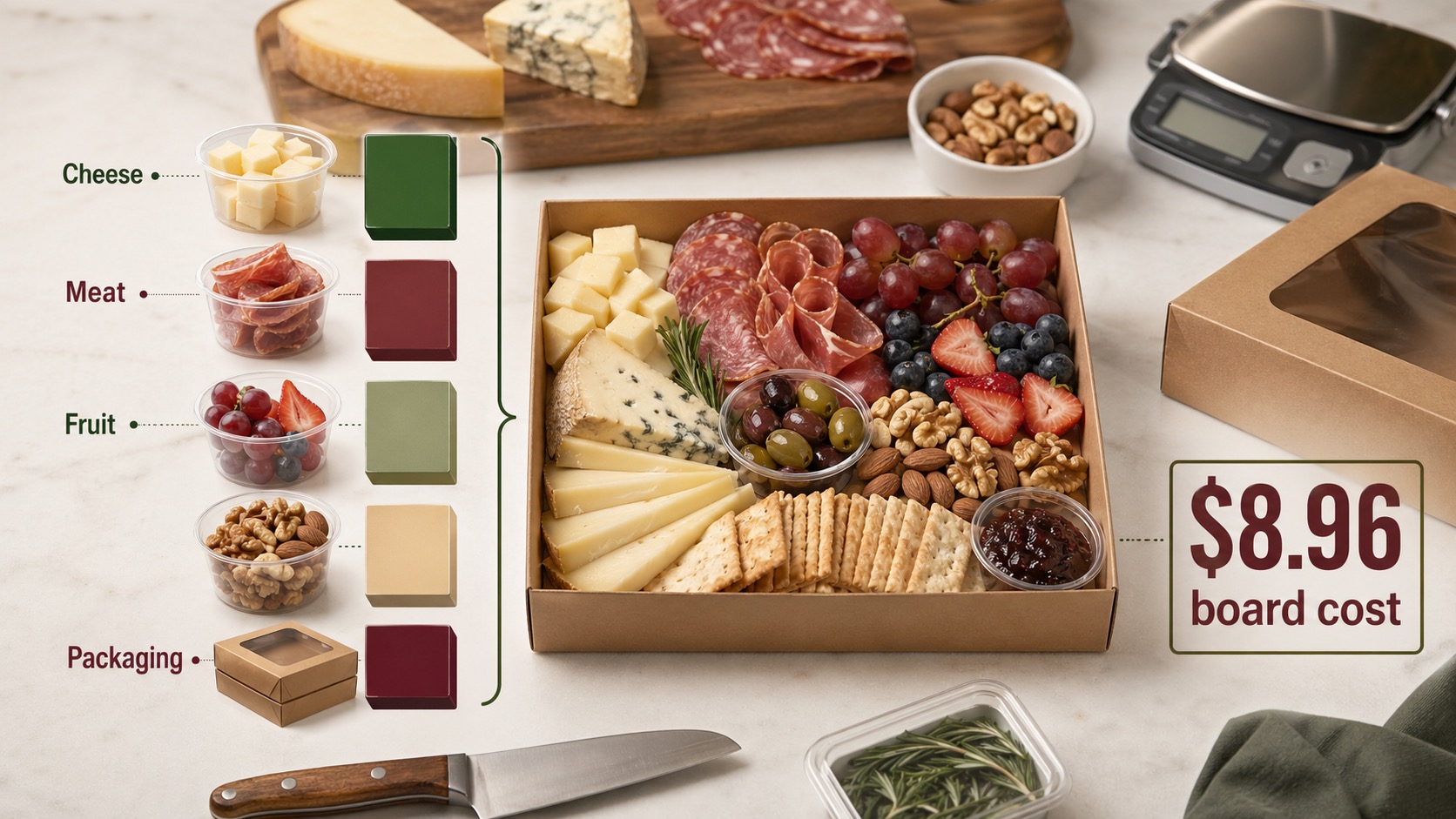
In this worked example, a 4-guest board costs $8.96 before assembly labor and overhead. At a 30% food-cost target, the price floor is $29.87, before any premium design, delivery, rush, or event fee.
Start Here: The Numbers to Check
- This guide is for charcuterie businesses pricing boards, grazing boxes, and party trays without guessing by visual size.
- The first numbers to check are cheese ounces, cured meat ounces, fruit, crackers, nuts, packaging, assembly time, and guest count.
- Start with
board cost = ingredients + packaging + labor, then divide by your target food cost or margin target. - The examples below build a four-guest board and a price ladder for 2, 4, and 8 guests.
- Today, cost one board by ounces per guest before quoting the next custom order.
Charcuterie Board Cost Formula
Start with the parts customers notice, then add the parts owners forget.
| Cost line | What to measure | Why it matters |
|---|---|---|
| Cheese | Ounces per guest, trim/rind loss | Usually the visual anchor |
| Cured meat | Ounces per guest | Portion creep is expensive |
| Crackers | Ounces or sleeves per board | Breakage and extras add up |
| Fruit | Ounces per guest | Spoilage can be high |
| Nuts | Ounces per guest | Small weight, high cost |
| Dip or jam | Cups and fill level | Easy to overfill |
| Packaging | Box, liner, cups, label, bag | Fixed cost on every board |
| Assembly time | Minutes per board | Small boards can be labor-heavy |
If you sell boards without a weight standard, the prettiest board becomes the least predictable one.
Four-Guest Board Example
Assumptions:
| Item | Portion | Unit cost |
|---|---|---|
| Cheese mix | 8 oz | $0.36/oz |
| Cured meat mix | 6 oz | $0.42/oz |
| Crackers | 4 oz | $0.12/oz |
| Fruit | 6 oz | $0.10/oz |
| Nuts | 2 oz | $0.30/oz |
| Jam | 1 oz | $0.25/oz |
| Pickles and olives | 1 set | $0.50 |
| Packaging | 1 set | $1.10 |
Cost table:
| Item | Line cost |
|---|---|
| Cheese | $2.89 |
| Cured meat | $2.54 |
| Crackers | $0.48 |
| Fruit | $0.60 |
| Nuts | $0.60 |
| Jam | $0.25 |
| Pickles and olives | $0.50 |
| Packaging | $1.10 |
| Total board cost | $8.96 |
Price floor:
$8.96 / 0.30 = $29.87Round with intent. A $30 board may work for a simple pickup box. A styled board, event drop-off, custom note, or premium cheese mix needs a higher price.
Build a Price Ladder
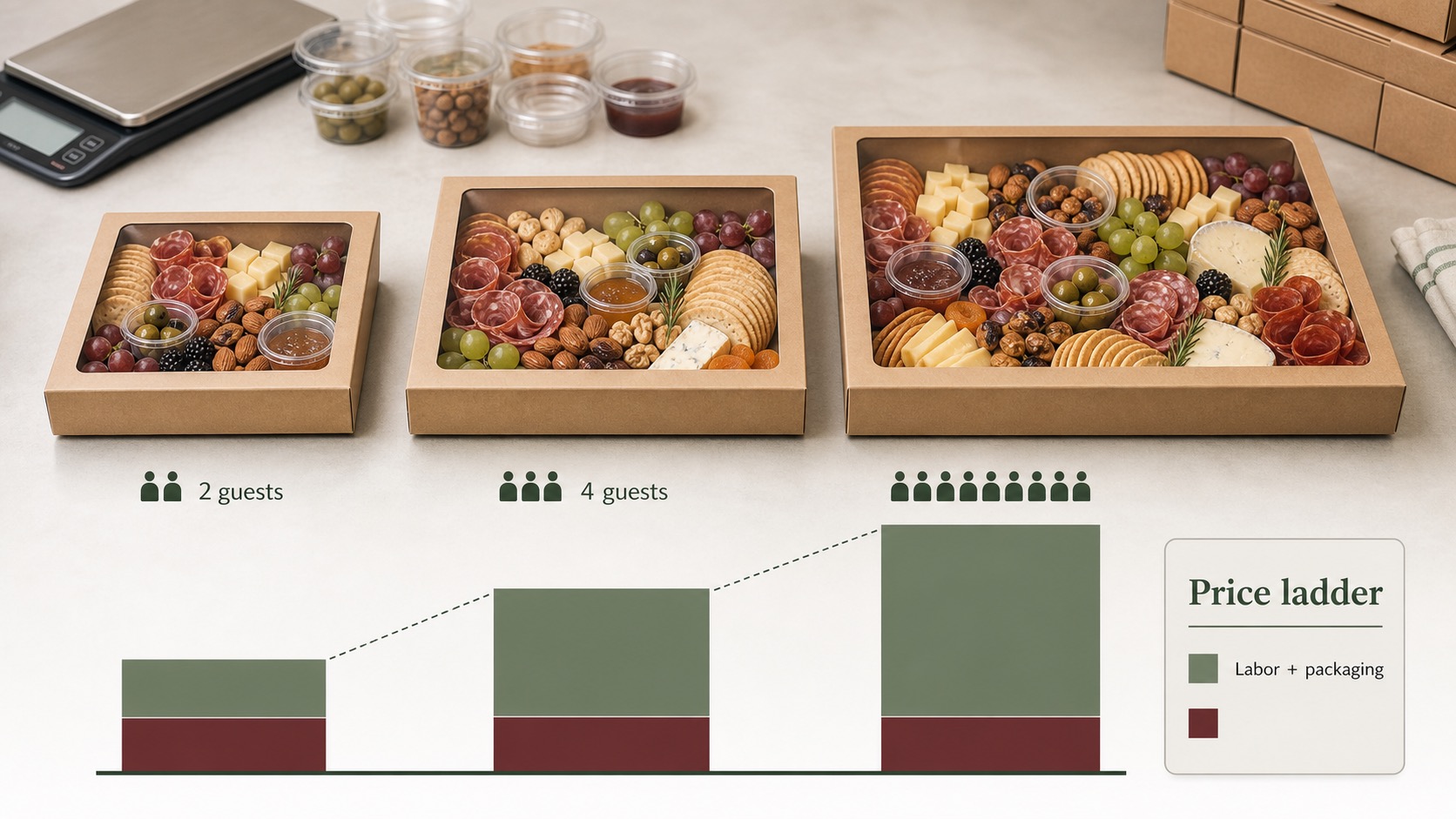
Small boards are not simply half of large boards.
| Board size | Why pricing changes | Safer pricing behavior |
|---|---|---|
| 2 guests | Packaging and assembly are large relative to food | Higher price per guest |
| 4 guests | Best balance of visual abundance and production time | Make this the anchor |
| 8 guests | More food, but packaging and labor scale better | Lower price per guest can work |
| Event board | Setup, travel, labels, dietary separation | Add service and logistics fees |
The common mistake is pricing a 2-person board too low because it “looks small.” The box, label, cups, pickup handling, and assembly time are still real.
The Portion Standard
Create a board card with these lines:
- Cheese ounces per guest
- Cured meat ounces per guest
- Crackers ounces per guest
- Fruit ounces per guest
- Nuts ounces per guest
- Dip or jam cup size
- Garnish rule
- Packaging SKU
- Assembly minutes
Then test the board visually. If the standard looks sparse, change the standard and the price together. Do not quietly add more cheese at the table.
Premium Add-Ons
Treat add-ons as their own mini recipes:
| Add-on | Costing rule |
|---|---|
| Extra cheese | Price by ounce plus handling |
| Prosciutto or premium cured meat | Separate from base cured meat mix |
| Honeycomb | Fixed portion and premium markup |
| Gluten-free crackers | Separate SKU and contamination note |
| Custom label or note | Packaging and admin time |
| Delivery | Mileage, handling, and remake risk |
Add-ons should raise average order value without breaking the board’s base margin.
Weekly Board Cost Audit
Do this after your busiest ordering day:
- Weigh one finished 4-guest board.
- Compare cheese and meat weight to the standard.
- Count wasted fruit and unused cut cheese.
- Update packaging cost if box or liner prices changed.
- Check whether small boards still cover assembly time.
- Adjust the ladder before adding new premium options.
This is especially useful for seasonal boards, where fruit, nuts, chocolate, herbs, and packaging change quickly.
Related Guides
- Catering Pricing Guide
- Recipe Costing Formula
- Baking Ingredient Cost Calculator
- Cupcake Cost Calculator
- Cookie Cost Calculator
Want Board Costs Done Automatically?
KitchenCost lets you store each ingredient, yield, packaging item, and target margin. Once the board card is built, changing cheese or box cost updates the price floor without rebuilding the spreadsheet.
Try KitchenCost to keep premium boards profitable.
Source Notes
The examples in this guide are model calculations. Use your own supplier prices, portion standards, packaging SKUs, labor assumptions, and local tax rules before publishing menu or catering prices.