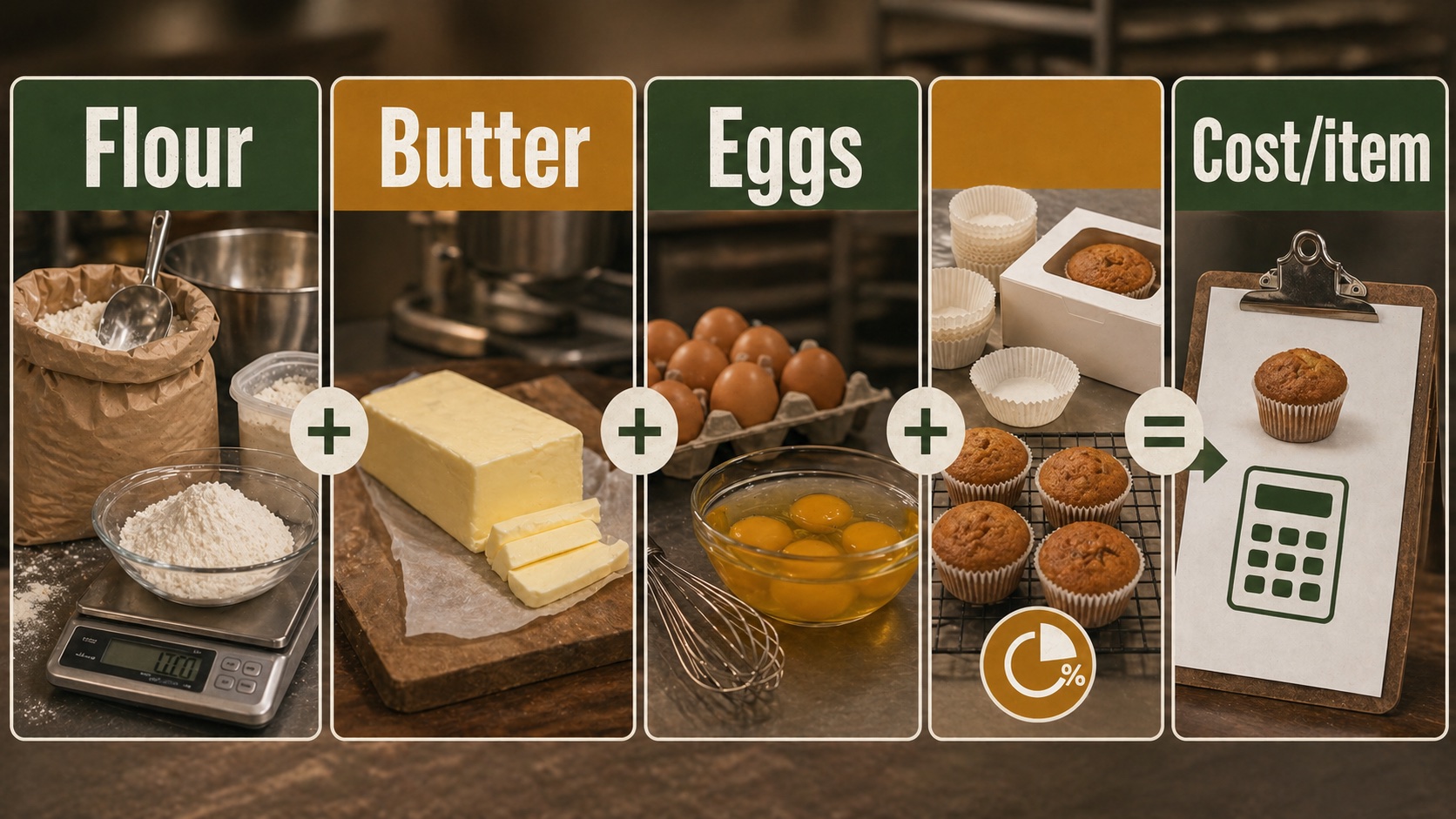
Baking ingredient cost is the cost of flour, butter, sugar, eggs, dairy, fillings, toppings, packaging, and waste for each sellable item. The fastest formula is: total batch cost ÷ sellable yield = cost per item.
Use this guide when you need a baking cost calculator workflow for cupcakes, cookies, bread, pastries, farmers market boxes, or custom orders.
Quick Answer
- Batch cost = sum of all ingredient costs + packaging + expected waste
- Cost per item = batch cost ÷ sellable yield
- Price floor = cost per item ÷ target food cost percentage
- Flour and sugar matter, but butter, eggs, chocolate, cream cheese, nuts, fruit, and packaging usually decide margin
- Cost cupcakes, cookies, loaves, and pastries separately; do not average them into one bakery percentage
The Baking Cost Formula
Every baked good starts with the same calculation:
Ingredient cost = unit cost x recipe amount
Batch cost = sum of ingredient costs + packaging + waste allowance
Cost per item = batch cost / sellable yield
Menu price floor = cost per item / target food cost %
The difficult part is not the formula. It is converting a 5 lb bag, a dozen eggs, a 1 lb butter block, or a 10 kg flour sack into the amount your recipe actually uses.
Ingredient Cost Table Template
Use this structure for every recipe.
| Ingredient | Purchase unit | Purchase price | Recipe amount | Line cost |
|---|---|---|---|---|
| Flour | 5 lb bag | your price | grams or ounces used | calculate |
| Sugar | 4 lb bag | your price | grams or ounces used | calculate |
| Butter | 1 lb block | your price | ounces used | calculate |
| Eggs | 12 count | your price | eggs used | calculate |
| Milk or cream | gallon/quart | your price | ml or oz used | calculate |
| Chocolate/nuts/fruit | bag/case | your price | amount used | calculate |
| Packaging | box/liner/label | your price | per item or order | calculate |
Keep the table boring and repeatable. A good costing sheet is not fancy; it is hard to misread during a busy prep day.
Example: 24 Cookies
Suppose a cookie batch has these sample costs:
| Cost bucket | Sample cost |
|---|---|
| Flour + sugar | $1.35 |
| Butter | $4.20 |
| Eggs + dairy | $1.10 |
| Chocolate chips | $4.80 |
| Vanilla, salt, leaveners | $0.50 |
| Packaging | $1.20 |
| Expected waste allowance | $1.25 |
| Total batch cost | $14.40 |
If the batch sells 24 cookies:
$14.40 / 24 = $0.60 per cookieIf you sell 4 oz cookies instead of 2 oz cookies, do not reuse the same cost. A larger cookie usually changes dough cost, bake loss, box choice, and price expectation.
Price Floor Formula
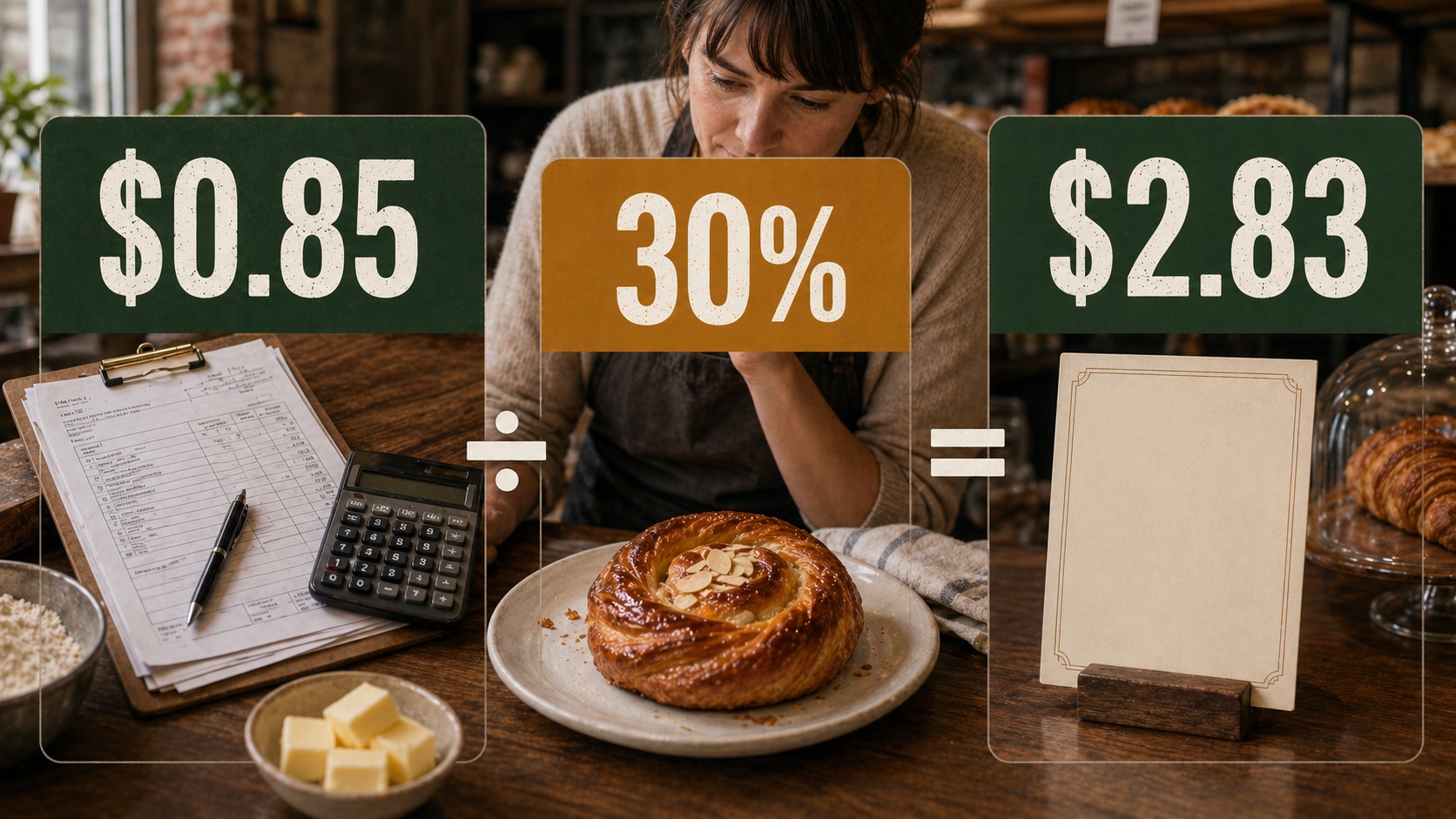
Once you know cost per item, set the price floor:
Minimum price = Cost per item / Target food cost %Example:
| Item | Cost per item | 30% food cost price floor | 25% food cost price floor |
|---|---|---|---|
| Cookie | $0.60 | $2.00 | $2.40 |
| Cupcake | $0.85 | $2.83 | $3.40 |
| Pastry | $1.40 | $4.67 | $5.60 |
| Mini loaf | $2.20 | $7.33 | $8.80 |
This is not your final retail price. It is the floor before labor, rent, delivery fees, market booth fees, spoilage, and profit target.
What Bakers Usually Forget
1. Packaging by format
A single cupcake, a dozen box, and a market variety pack do not have the same packaging cost. Add boxes, liners, labels, bags, ribbons, stickers, inserts, and sampling cups to the correct format.
2. Yield loss
If a batch makes 24 items but only 22 are good enough to sell, the cost per sellable item is based on 22, not 24.
3. Premium ingredients
Chocolate, nuts, fruit, cream cheese, buttercream, ganache, and filled centers should be costed as real add-ons. If a premium add-on costs $0.30 and your target food cost is 30%, it needs about a $1.00 price increase.
4. Labor-heavy decoration
Ingredient cost does not capture detailed piping, fondant, edible flowers, custom color matching, or rush work. Treat those as price modifiers, not standard ingredients.
Product-Specific Notes
| Product | Watch first | Pricing mistake to avoid |
|---|---|---|
| Cookies | portion weight and mix-ins | treating 2 oz and 4 oz as one product |
| Cupcakes | frosting, packaging, toppings | discounting dozens too heavily |
| Bread | yield and bake loss | ignoring unsold end-of-day loaves |
| Pastries | butter and laminated dough waste | pricing like simple bread |
| Custom cakes | decoration time and supports | charging only for batter and frosting |
What To Do This Week
- Pick your top 3 selling baked goods.
- Cost the recipe using current supplier prices.
- Add packaging and expected waste.
- Calculate the price floor at 25%, 30%, and 35% food cost.
- Flag any item where your current price is below the floor.
If one item is underpriced, fix that first. A small price correction on a best seller usually beats a big correction on a slow seller.
Related Guides
- Recipe Costing Formula — Full recipe costing workflow
- US Cookie Shop Cost Guide — 2 oz vs 4 oz cookie and box pricing
- US Cupcake Bakery Cost Guide — Singles, dozens, toppings, and custom orders
- US Dumpling Shop Cost Guide — Batch prep and filling cost logic
- US Restaurant Labor Cost Calculator — Add labor after ingredient cost
KitchenCost helps bakers store ingredient prices once, build recipes, and see cost per item as prices change.
Method Notes
This guide uses durable costing formulas and sample numbers for illustration. Replace sample prices, yields, and packaging costs with your own invoices and prep records.