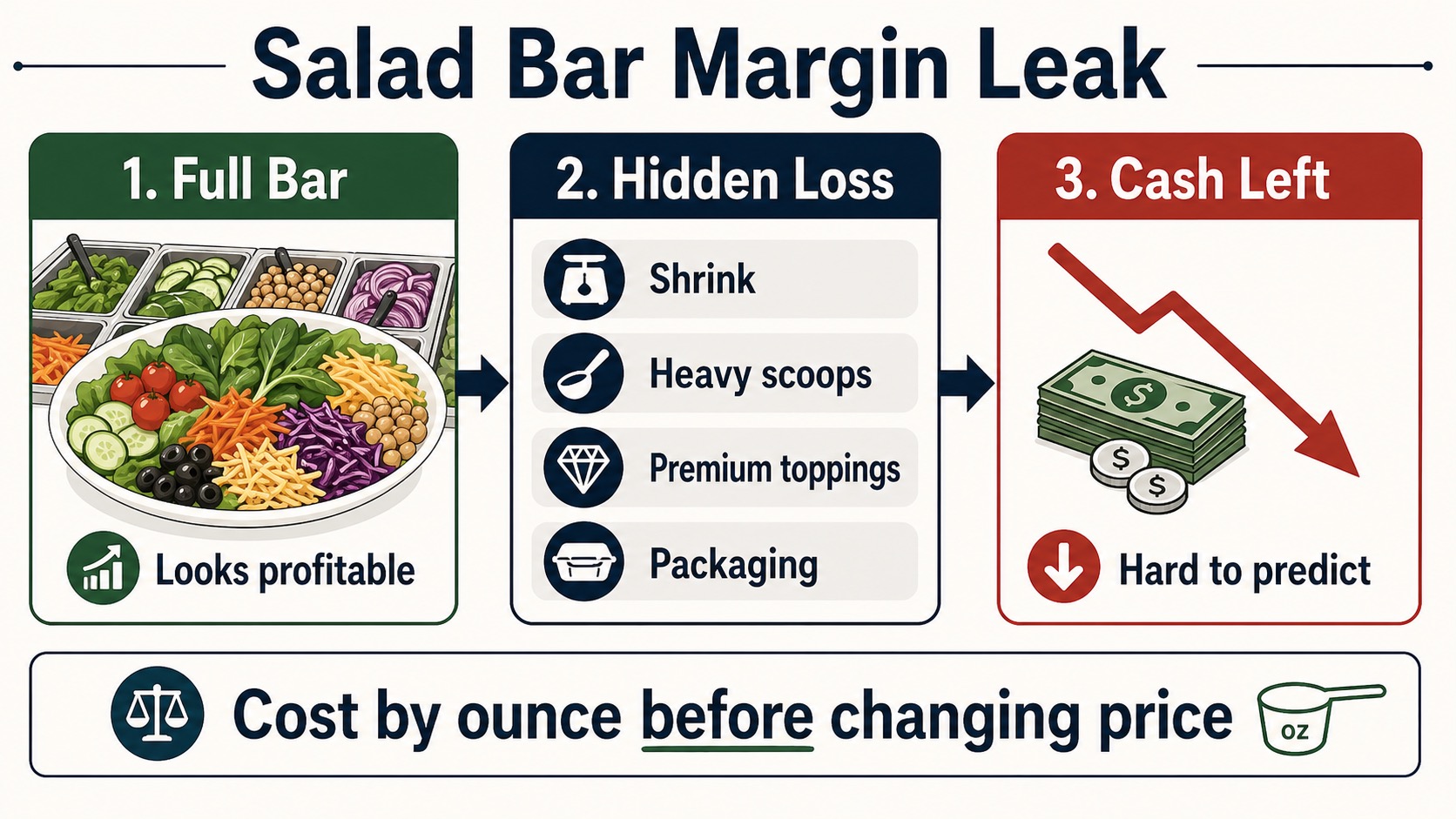
A salad bar can look full, fresh, and popular while quietly missing its margin target.
The leak is rarely one dramatic line item. It is usually a mix of wilted greens, heavy protein scoops, premium toppings treated as free, and packaging that never made it into the cost card.
If you run a salad bar or build-your-own bowl station, the decision rule is simple: cost by ounce before you change the menu price.
Start Here: The Numbers to Check
- This guide is for salad bars and build-your-own bowl programs where heavy scoops, shrink, and premium toppings can erase margin.
- The first numbers to check are cost per ounce by ingredient, protein scoop size, dressing, packaging, shrink, and comped toppings.
- Start with
bowl cost = ingredient ounces x cost per ounce + packaging + shrink allowance. - The examples below show how to build a cost-per-ounce table and where fixed pricing gets risky.
- Today, weigh one protein scoop and one premium topping scoop during service, not just during prep.
The Numbers to Put on One Sheet
| Input | Why it matters |
|---|---|
| Cost per usable ounce | Includes trim and spoilage, not just invoice cost |
| Average bowl weight | Controls the real cost of a fixed-price bowl |
| Protein scoop weight | Usually the highest-cost portion error |
| Premium toppings | Avocado, cheese, nuts, bacon, shrimp |
| Packaging | Bowl, lid, bag, cutlery, dressing cup |
| Shrink | End-of-day throwaway and prep loss |
If those numbers live in different places, the price is a guess.
Core Formula
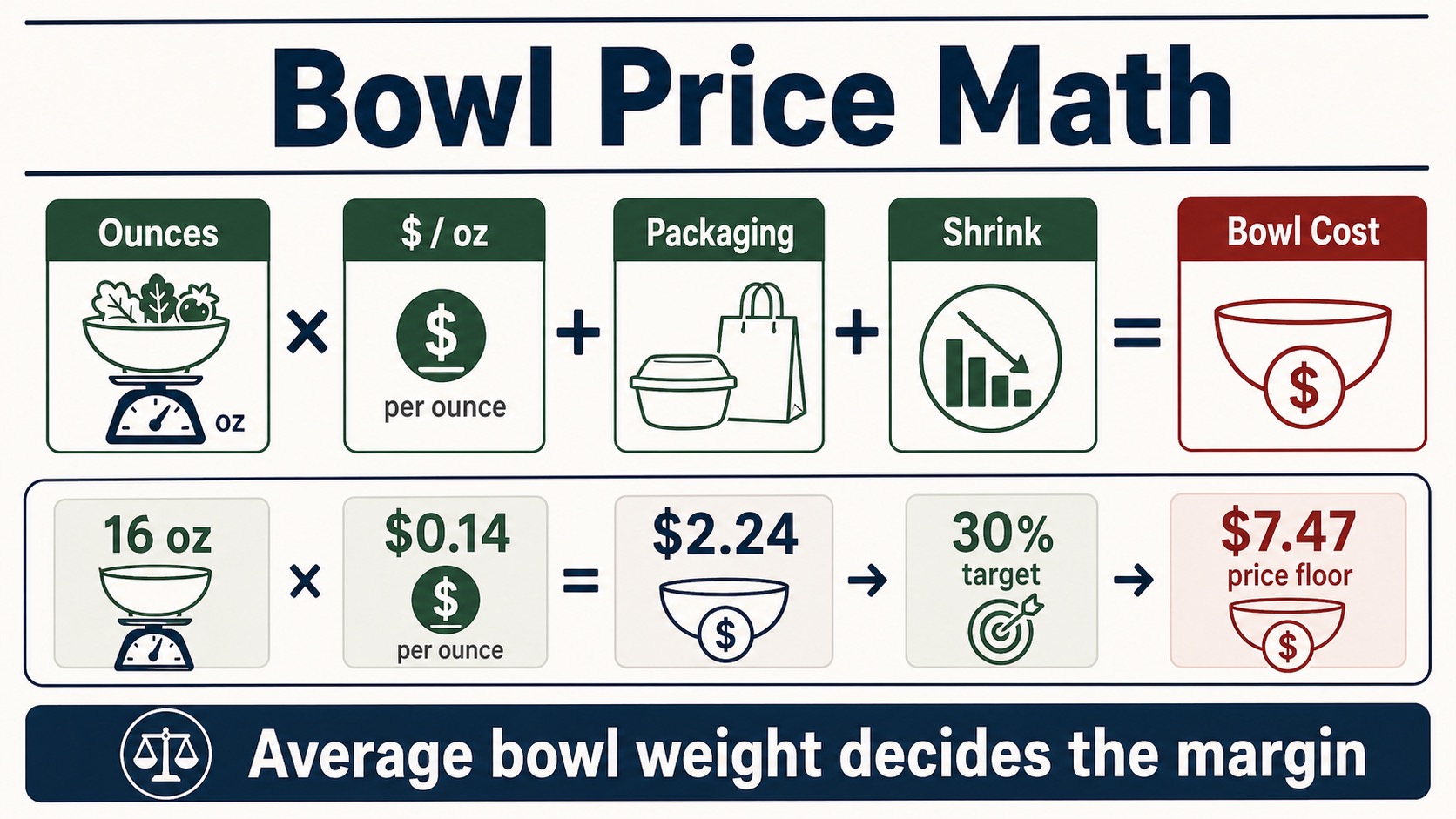
Bowl cost = (average ounces x cost per ounce) + packaging + shrink allowance

Price floor = bowl cost / target food cost rate
Example:
16 oz average bowl x $0.14 per oz = $2.24

$2.24 / 0.30 = $7.47 price floor
That does not mean every bowl should be $7.47. It means a fixed-price salad bar below that number needs tighter portioning, cheaper mix, or a separate protein charge.
Why Fixed Price Gets Risky
Fixed price feels simple to customers and staff. The problem is that customers do not build average bowls. Some build light bowls. Some build protein-heavy bowls with premium toppings.
| Pricing model | Strength | Risk |
|---|---|---|
| Price by weight | Built-in portion control | Slower line, scale needed |
| Fixed bowl price | Simple and fast | Heavy bowls compress margin |
| Base + paid protein | Clear margin control | Requires staff/menu discipline |
| Tiered bowl sizes | Easier to explain | Portion standards must be enforced |
For most small operators, the safest structure is a base bowl with paid protein and premium add-ons. It keeps the menu easy while protecting the items that move cost fastest.
Build a Cost-Per-Ounce Table
Start with a table like this, using your actual invoices.
| Item | Usable $/oz | Standard portion | Line cost | Watch item |
|---|---|---|---|---|
| Greens mix | $0.12 | 4 oz | $0.48 | Shrink |
| Chicken | $0.26 | 4 oz | $1.04 | Heavy scoops |
| Tomatoes | $0.12 | 2 oz | $0.24 | Prep waste |
| Cheese | $0.55 | 0.6 oz | $0.33 | Portion creep |
| Dressing | $0.12 | 2 oz | $0.24 | Over-pour |
| Packaging | — | 1 set | $0.28 | Takeout mix |
The exact values will differ by market and supplier. The operating habit is what matters: usable ounce, standard portion, line cost.
The Four Places Salad Bar Margin Leaks
1. Shrink
Greens, tomatoes, herbs, and cut vegetables lose value quickly after prep. Track what gets thrown away by ingredient, not just by total dollar amount.
2. Heavy protein scoops
Chicken, shrimp, steak, tofu, eggs, and cheese need measured scoops. One generous employee can turn a profitable bowl into a thin one during lunch rush.
3. Premium toppings treated as garnish
Avocado, nuts, bacon, premium cheese, and specialty dressings should not disappear inside a fixed bowl price unless the portion is tightly controlled.
4. Packaging
Takeout salad bowls need lids, bags, cutlery, and often separate dressing cups. If packaging is not in the bowl cost, delivery and grab-and-go margins will look better than they are.
Weekly Control Loop
| Weekday | 10-minute check |
|---|---|
| Monday | Update protein and premium topping costs |
| Tuesday | Weigh 10 finished bowls and average the ounces |
| Wednesday | Measure protein scoop variance |
| Thursday | Record shrink by ingredient |
| Friday | Decide one change: price, portion, or prep volume |
KitchenCost can hold the cost-per-ounce table, recipe standards, and packaging assumptions in one place, so the team is not rebuilding the math every time invoices move.
Operator Rule
Do not start with “Should we raise the bowl price?”
Start with “What is the average bowl weight, and which ounces are expensive?”
Once you know that, the fix is usually obvious: limit proteins, charge for premium toppings, change prep batches, or move the price.
Related Guides
Notes
- Cost examples are operating examples for salad bar pricing. Replace them with invoice costs, actual yield, and average bowl weight from your store.