
BBQ restaurant cost breaks when the owner prices the plate from the menu board instead of the smoker. Brisket, ribs, pulled pork, and chicken do not have the same yield, labor, or target food cost.
In this worked example, an 8 oz brisket plate with two sides costs $5.98 before labor and overhead. At a 32% food-cost target, the price floor is $18.69.
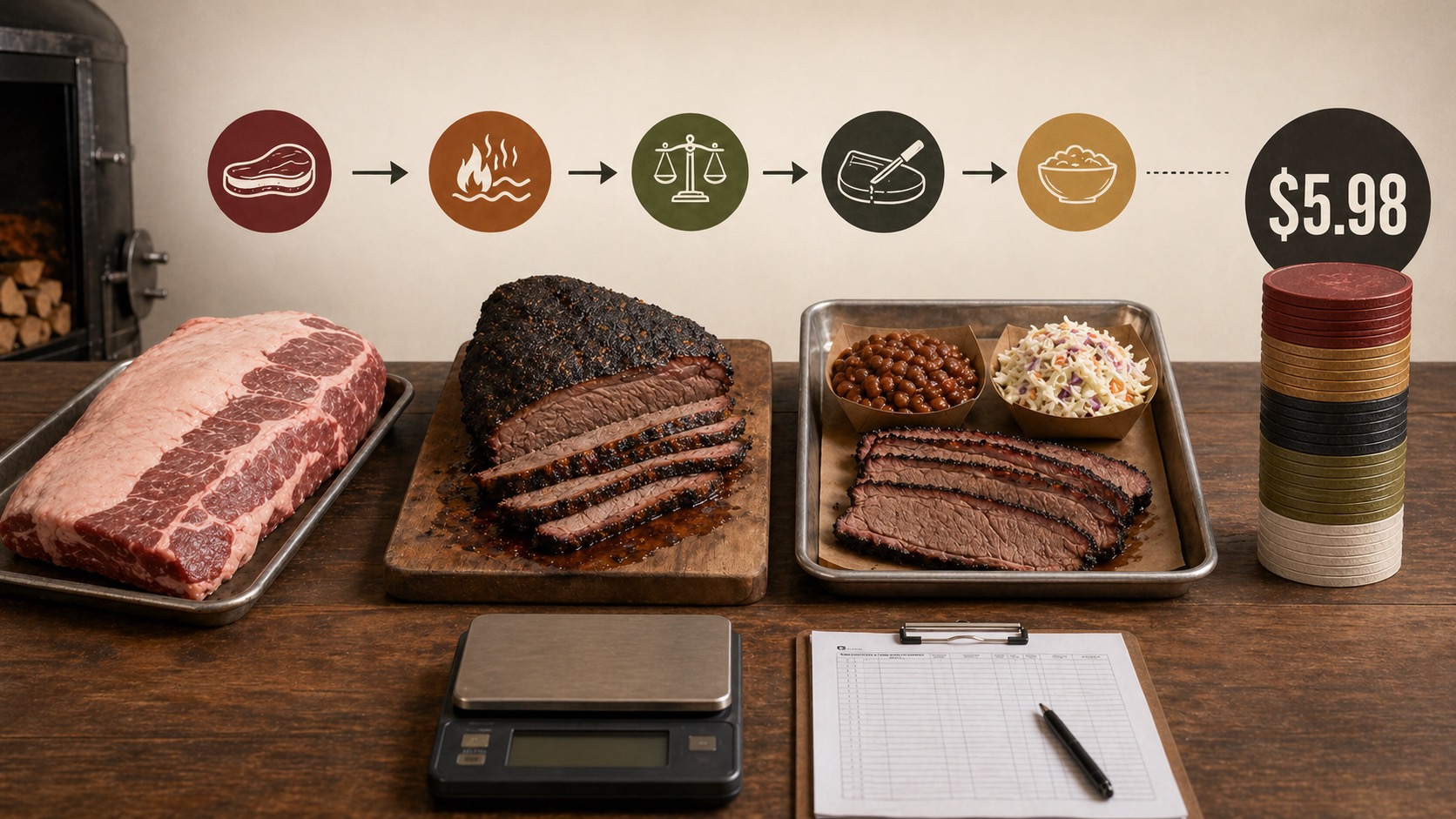
Quick Answer
Use this formula for every smoked protein:
Cooked cost per lb = Raw price per lb / Cooked yield %
Protein portion cost = Cooked cost per lb x Portion lb
Plate cost = Protein + sides + sauce + bread + packaging
Price floor = Plate cost / Target food cost %
The decision rule is simple: never price brisket, ribs, pork, and chicken from one blended BBQ margin. Cost each cut separately, then let sides and drinks carry part of the margin.
BBQ Cost Formula
BBQ costing starts before the meat goes into the smoker.
| Cost line | What to enter | Why it matters |
|---|---|---|
| Raw meat price | Supplier price per lb | The number that changes fastest |
| Trim loss | Fat cap, bone, unusable edges | Raises real protein cost |
| Cooked yield | Finished weight / raw weight | Turns raw price into cooked cost |
| Portion weight | Ounces served | Main source of daily margin drift |
| Sides | Scoop weight and recipe cost | Keeps plates profitable |
| Sauce and bread | Fixed portion | Often ignored until volume grows |
| Packaging | Tray, liner, cup, bag | Required for takeout and delivery |
For brisket, the owner-safe move is to weigh one finished brisket every week:
Smoked yield % = Finished usable weight / Raw trimmed weightIf the yield drops from 69% to 62%, the same raw brisket invoice produces a much more expensive plate.
Brisket Plate Example
Assumptions:
| Input | Amount |
|---|---|
| Raw brisket price | $5.51/lb |
| Cooked yield | 69% |
| Brisket portion | 8 oz |
| Mac and cheese | 4 oz at $0.22/oz |
| Slaw | 4 oz at $0.16/oz |
| Pickles | 1 oz at $0.12/oz |
| Sauce | 1 oz at $0.10/oz |
| Bread | 1 slice at $0.25 |
Brisket math:
Cooked brisket cost per lb = 5.51 / 0.69 = $7.99
8 oz brisket portion = 0.5 lb x 7.99 = $3.99
Plate cost:
| Item | Line cost |
|---|---|
| Brisket | $3.99 |
| Mac and cheese | $0.88 |
| Slaw | $0.64 |
| Pickles | $0.12 |
| Sauce | $0.10 |
| Bread | $0.25 |
| Total plate cost | $5.98 |
Price floor:
$5.98 / 0.32 = $18.69That means a $17.99 brisket plate is already tight before labor, rent, utilities, payment fees, remakes, and comped sides.
Ribs, Pork, Chicken, and Sides Need Separate Targets
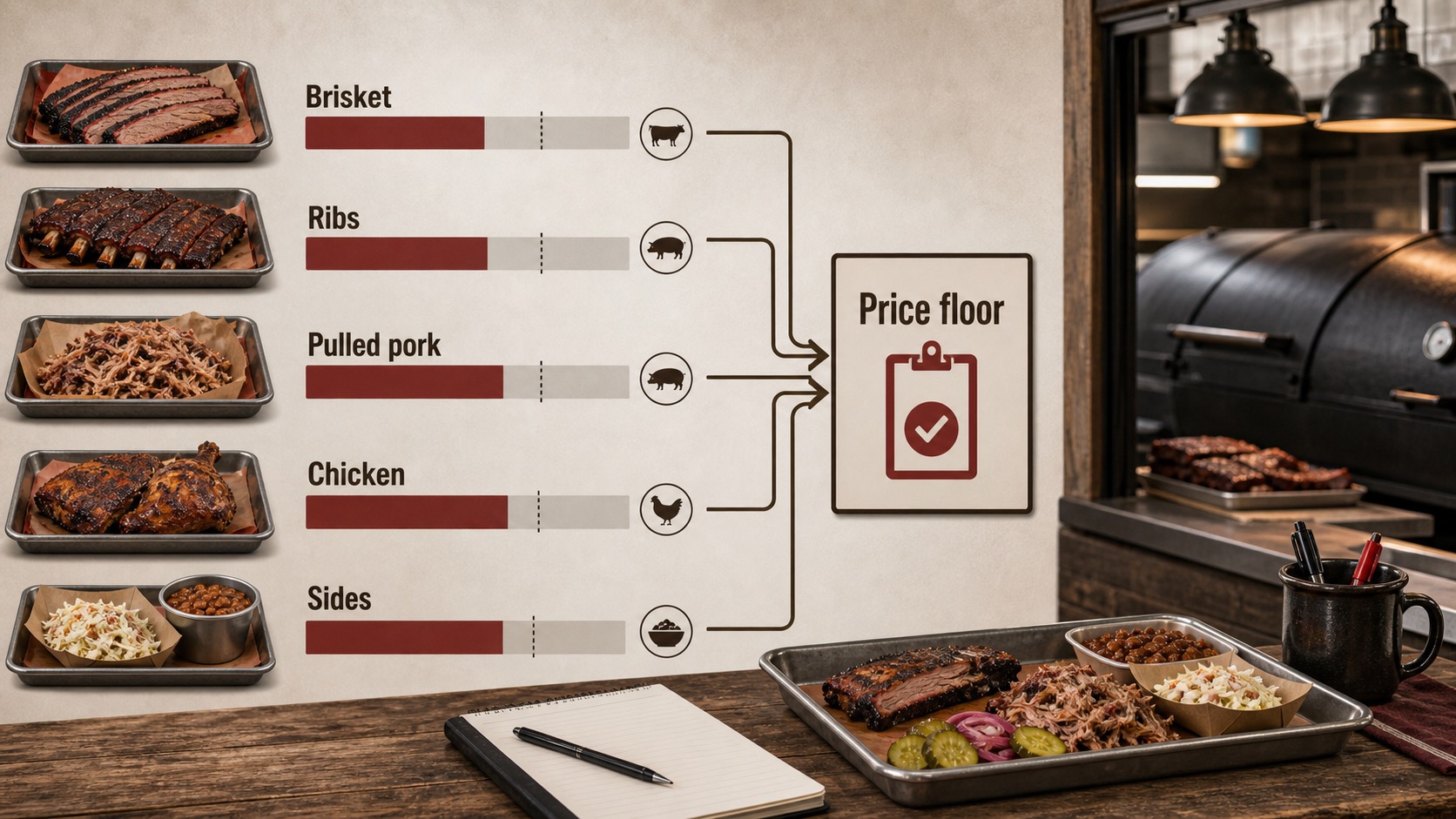
One blended BBQ food-cost target hides which items are funding the menu.
| Item type | Typical pricing role | Safer target behavior |
|---|---|---|
| Brisket plate | Traffic driver, high perceived value | Higher food cost is acceptable only if portions are locked |
| Rib plate | Labor-heavy premium item | Price high enough to cover trim, glaze, and holding risk |
| Pulled pork sandwich | Margin anchor | Keep portion tight and use it for value bundles |
| Smoked chicken | Entry price point | Protects check accessibility without underpricing brisket |
| Sides | Margin buffer | Standardize scoops and attach to protein plates |
| Drinks | Profit support | Use to offset high-cost protein plates |
The biggest mistake is underpricing ribs and brisket to match nearby competitors while hoping sides will fix the math. Sides help, but they cannot rescue a protein plate that starts below its price floor.
Portion Drift Rule
If cooked brisket costs $7.99/lb, then:
1 oz cooked brisket = $7.99 / 16 = $0.50One extra ounce on 60 brisket plates is about $30 of food cost in one service. That is not hospitality. That is an unmanaged discount.
Use this rule:
- Brisket is weighed by ounces, not slice count.
- Pulled pork gets a fixed scoop or weighed deli paper.
- Sides use portion scoops, not spoon judgment.
- Sauce cups have a fill line.
- Takeout trays are costed as part of the plate, not overhead.
Delivery and Takeout
BBQ travels well, but the packaging is not free. A delivery brisket plate may need a larger tray, side cups, sauce cups, napkins, liner, bag, and a remake buffer if sauce leaks.
For takeout-heavy menus, create a separate price check:
Takeout plate cost = Dine-in plate cost + packaging + remake buffer
Takeout price floor = Takeout plate cost / Target food cost %
If delivery orders use third-party platforms, treat platform deductions as a separate channel-margin calculation. Do not hide them inside the food-cost percentage.
Weekly BBQ Cost Audit
Do this before the weekend rush:
- Update raw prices for brisket, ribs, pork, chicken, and wings.
- Weigh one cooked brisket and one cooked pork shoulder.
- Recalculate cooked cost per lb for each cut.
- Spot-check three random plates for protein and side weight.
- Update price floors for the top five sellers.
- Decide whether to adjust menu price, portion size, bundle structure, or feature placement.
This is a 15-minute habit. The point is not perfect accounting. The point is catching the drift before a busy weekend turns it into a monthly margin problem.
Related Guides
- Recipe Costing Formula
- Chicken Wing Cost Calculator
- Delivery App Pricing for Restaurants
- Catering Pricing Guide
- Burger Restaurant Cost Guide
Want BBQ Cost Cards Done Faster?
KitchenCost lets you store raw cost, yield, portion size, sides, sauces, and price targets for every menu item. When brisket or rib prices move, you update the ingredient once and see which plates need attention.
Start with your best-selling brisket plate, then add pork, ribs, chicken, and sides.
Try KitchenCost to stop rebuilding BBQ math from scratch.
Source Notes
The examples in this guide are model calculations for operators. Use your own supplier invoices, finished weights, and portion standards before publishing menu prices.
For yield references, compare your own pit records with published cooking-yield resources such as USDA ARS Cooking Yields for Meat and Poultry and smoked brisket yield research from Meat and Muscle Biology.