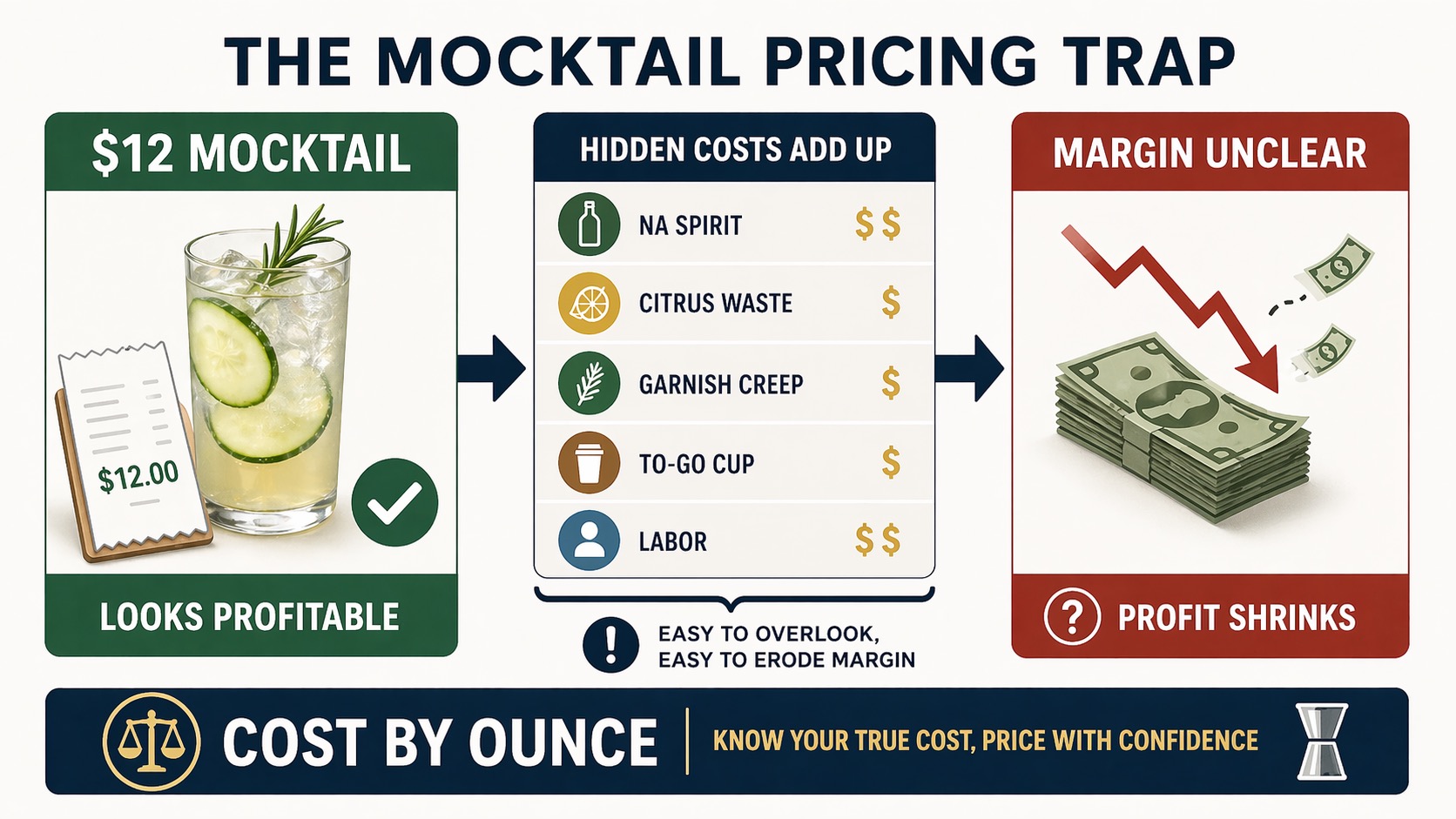
Mocktails look like easy margin until the bar starts building them like cocktails and pricing them like soda.
The leak usually hides in small places: premium non-alcoholic spirits, fresh citrus, herbs, garnish prep, ice, broken batch yield, and to-go cups. A $12 drink can still work, but only if it is costed by the ounce.
Start Here: The Numbers to Check
- This guide is for bars and restaurants adding mocktails without letting NA spirits, juice, garnish, and labor hide inside a $12 drink.
- The first numbers to check are ounces of NA spirit, juice, syrup, garnish, ice, glassware or to-go packaging, and prep labor.
- Start with
drink cost = ingredients + garnish + packaging + labor allowance, then set the menu tier from the target pour cost. - The examples below show where mocktail margin leaks and how to price by drink tier.
- Today, cost one signature mocktail ounce by ounce before copying cocktail menu prices.
At a Glance: Where Mocktail Margin Leaks
| Cost driver | Why it gets missed | What to do |
|---|---|---|
| NA spirit | Priced like a splash, poured like a base | Measure by ounce and make premium builds a tier |
| Citrus juice | Prep feels cheap until waste shows up | Track usable yield, not whole-fruit purchase cost |
| Herbs and garnish | Staff add extra to make it feel special | Set a garnish spec and portion container |
| Batch loss | Leftover mix dies after service | Cost the batch by usable servings |
| Ice and glassware | Ignored because it feels small | Include for to-go and high-volume service |
| Labor | Mocktails can take cocktail-level time | Simplify builds for rush periods |
The goal is not to make every mocktail expensive. The goal is to stop premium builds from subsidizing the rest of the menu.
Build a Cost Sheet for One Drink
Use one row per ingredient.
| Component | Example cost |
|---|---|
| Citrus base | $0.62 |
| Syrup or shrub | $0.34 |
| NA spirit, 1 oz | $0.95 |
| Bitters or functional ingredient | $0.18 |
| Garnish | $0.32 |
| Ice, cup, lid, straw | $0.39 |
| Estimated rush labor add-on | $0.20 |
| Total drink cost | $3.00 |
At a 22% target:
$3.00 / 0.22 = $13.64That drink belongs at $14, or it needs a simpler build.
Decide the Tier Before You Rewrite the Menu
Not every non-alcoholic drink should do the same job.
| Tier | Menu role | Pricing rule |
|---|---|---|
| Simple refresher | Easy add-on, lunch, patio | Keep build cost low and fast |
| House mocktail | Main NA menu anchor | Use 20-25% pour cost target |
| Premium NA spirit drink | Cocktail alternative | Price closer to cocktails or use modifier pricing |
| To-go mocktail | Delivery/takeout add-on | Include cup, lid, ice loss, and remake risk |
If a premium NA spirit is buried inside the base mocktail price, staff will sell more of the drink that quietly lowers your margin. Make the premium version visible and priced.
The Better Decision Rule
Use this rule for every new mocktail:
- Cost the exact recipe by ounce.
- Add garnish and packaging.
- Divide by target pour cost.
- Compare the result with the cocktail menu and the check average.
- If the price feels too high, simplify the build before discounting it.
Discounting should be the last move. Recipe design is usually the cheaper fix.
Inflation Context for 2026
The U.S. BLS March 2026 CPI release showed food away from home up 3.8% year over year, with full-service meals and snacks up 4.3%. Nonalcoholic beverages and beverage materials were also up 4.7% year over year.
That does not mean every mocktail needs an immediate price increase. It does mean the drink list should be reviewed on a schedule, not only after beverage margin drops.
14-Day Mocktail Margin Audit
- Pull your top 10 non-alcoholic drinks by units sold.
- Cost each recipe by ounce, not by estimated splash.
- Add garnish, ice, and to-go packaging.
- Mark drinks above your target pour cost.
- Simplify one high-labor build before raising price.
- Move premium NA spirits into a visible modifier or premium tier.
- Recheck sales mix after two weekends.
How KitchenCost Fits
KitchenCost is useful here because mocktail pricing is recipe costing, not just bar instinct. Once the citrus price, NA spirit bottle cost, garnish spec, or cup cost changes, the drink cost should change too.
Track each mocktail as a recipe, then review the menu before the next seasonal update. That keeps a popular NA program from becoming a quiet margin leak.
Related Guides
Sources
Verified on 2026-04-24.
- U.S. Bureau of Labor Statistics, Consumer Price Index News Release, March 2026: https://www.bls.gov/news.release/archives/cpi_04102026.htm
The recipe examples above are operating examples. Replace the bottle cost, ounce spec, garnish cost, and packaging cost with your supplier invoices before changing prices.