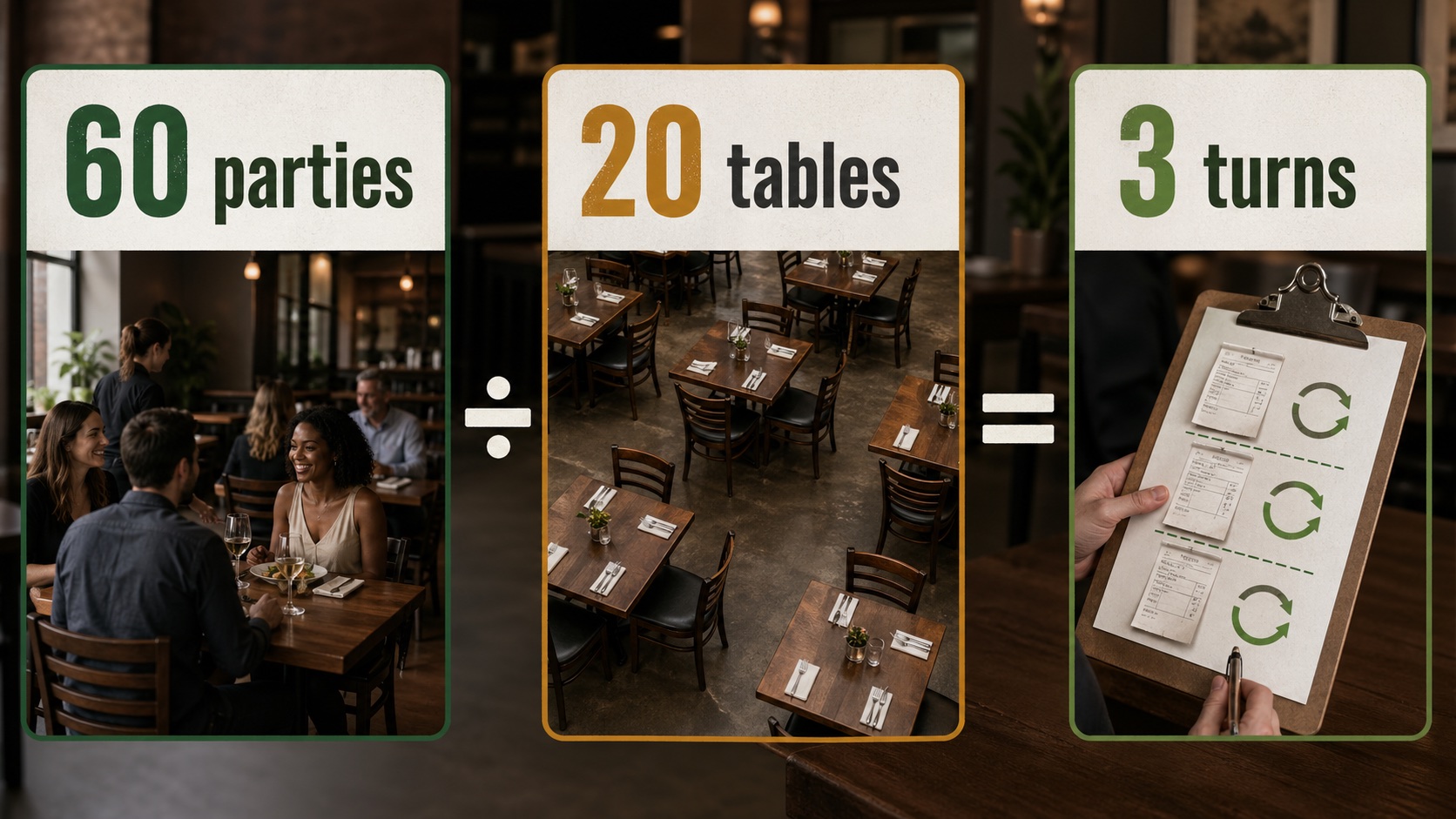
Table turnover rate means how many parties each table serves during one period. The formula is parties served ÷ number of tables. If 60 parties use 20 tables during dinner, your table turnover rate is 3 turns.
This guide covers the definition, the formula, an 80-seat restaurant example, practical benchmarks, and ways to improve turns without making guests feel rushed.
Quick Summary
- Table turnover rate = Parties served ÷ Number of tables (per period)
- In plain English: it shows how often each table is reused to generate revenue
- 80 seats with 4 seats per table = about 20 tables
- Fast-casual: 3-4 turns/meal period
- Casual dining: 1.5-2 turns/meal period
- Fine dining: 1 turn/evening
- Improve turns with faster seating, streamlined service, and check drop timing
- Track RevPASH (Revenue Per Available Seat Hour) to combine turnover + check size
What Is Table Turnover in a Restaurant?
Table turnover is how many parties each table serves during a time period, usually lunch, dinner, or the full day.
If one table serves 3 different parties during dinner, that table had 3 turns.
When people search for “what is table turnover” or “what is a turn in a restaurant,” this is the core concept: how often seats are reused to generate revenue.
Table Turnover vs. Seat Turnover vs. Turnaround Time
These terms sound similar, but they answer different operating questions.
| Metric | Formula | Answers |
|---|---|---|
| Table turnover rate | Parties served ÷ tables | How many times each table is reused |
| Seat turnover | Guests served ÷ seats | How many guest seats were used |
| Seat utilization | Guests seated ÷ available seats | Whether tables are being filled efficiently |
| Turnaround time | Next seating time - guest departure time | How fast a table is reset after a party leaves |
If a 4-top seats only 2 guests all night, table turnover can look healthy while seat utilization is weak. If guests leave quickly but resets take 12 minutes, your problem is turnaround time, not guest pacing.
Why Table Turnover Matters
Here is the basic restaurant revenue formula:
Revenue = Seats × Seat Utilization × Turnover × Average CheckYou can’t add more seats (fixed layout). You can’t always raise prices (market limits).
That leaves utilization (how full you are) and turnover (how often tables flip).
If your turnover is 1.5 instead of 2, you’re leaving 25% of potential revenue on the table — literally.
How to Calculate Table Turnover Rate
The formula is simple:
Table Turnover Rate = Number of Parties Served ÷ Number of TablesYou can calculate this per meal period (lunch, dinner) or per day.
Example: Dinner Service
- Tables: 25
- Parties served: 50
- Turnover rate: 50 ÷ 25 = 2 turns
Example: Full Day
- Tables: 25
- Lunch parties: 40
- Dinner parties: 50
- Total: 90 parties
- Daily turnover: 90 ÷ 25 = 3.6 turns
80 Seats Example: Quick Turnover Formula
Operators often ask: “How do I calculate turnover rate if I have 80 seats?”
If you already know your table count, use the exact number. If you only know seat count, use this two-step estimate:
- Convert seats to estimated tables
- Divide parties served by tables
Example with 80 seats:
- Average seats per table: 4
- Estimated tables: 80 ÷ 4 = 20
- Dinner parties served: 110
- Turnover rate: 110 ÷ 20 = 5.5 turns
If your average party size is smaller than table size, also track seat utilization so you do not overestimate true capacity performance.
Industry Benchmarks by Restaurant Type
Use these as planning ranges, not a universal target. Your real benchmark depends on concept, menu pacing, check size, reservation mix, and service style.
| Restaurant Type | Average Turn Time | Turns per Meal Period | Daily Turns |
|---|---|---|---|
| Fast casual | 20-30 min | 3-4 | 8-12 |
| Casual dining | 45-60 min | 1.5-2 | 3-5 |
| Upscale casual | 60-75 min | 1.2-1.5 | 2.5-4 |
| Fine dining | 90-120 min | 1 | 1-2 |
| Cafe/Coffee shop | 15-25 min | 4-6 | 12-20 |
The benchmark that matters is your own. Track weekly and compare to your historical average.
When Turnover Looks Good but Revenue Still Feels Low
High table turnover does not always mean high capacity performance.
Example:
- 4-top table
- 2 guests per party average
- 3 table turns
- Guest seats used: 2 × 3 = 6
- Seat utilization: 2 ÷ 4 = 50%
In that case, the issue is not speed. The issue is table mix, party-size matching, or how reservations are assigned. A two-top sitting at a four-top can make turnover look fine while revenue per seat stays weak.
RevPASH: The Metric That Combines Everything
RevPASH = Revenue Per Available Seat Hour
It combines check size, turnover, and utilization into one number.
RevPASH = Total Revenue ÷ (Total Seats × Hours Open)Example
- 80 seats
- 5-hour dinner service
- $8,000 in revenue
RevPASH = $8,000 ÷ (80 × 5) = $20 per seat hour
Track RevPASH weekly. If it’s going up, your overall efficiency is improving — whether from turnover, check size, or utilization.
What Slows Down Table Turnover
Before you try to speed things up, understand where time goes.
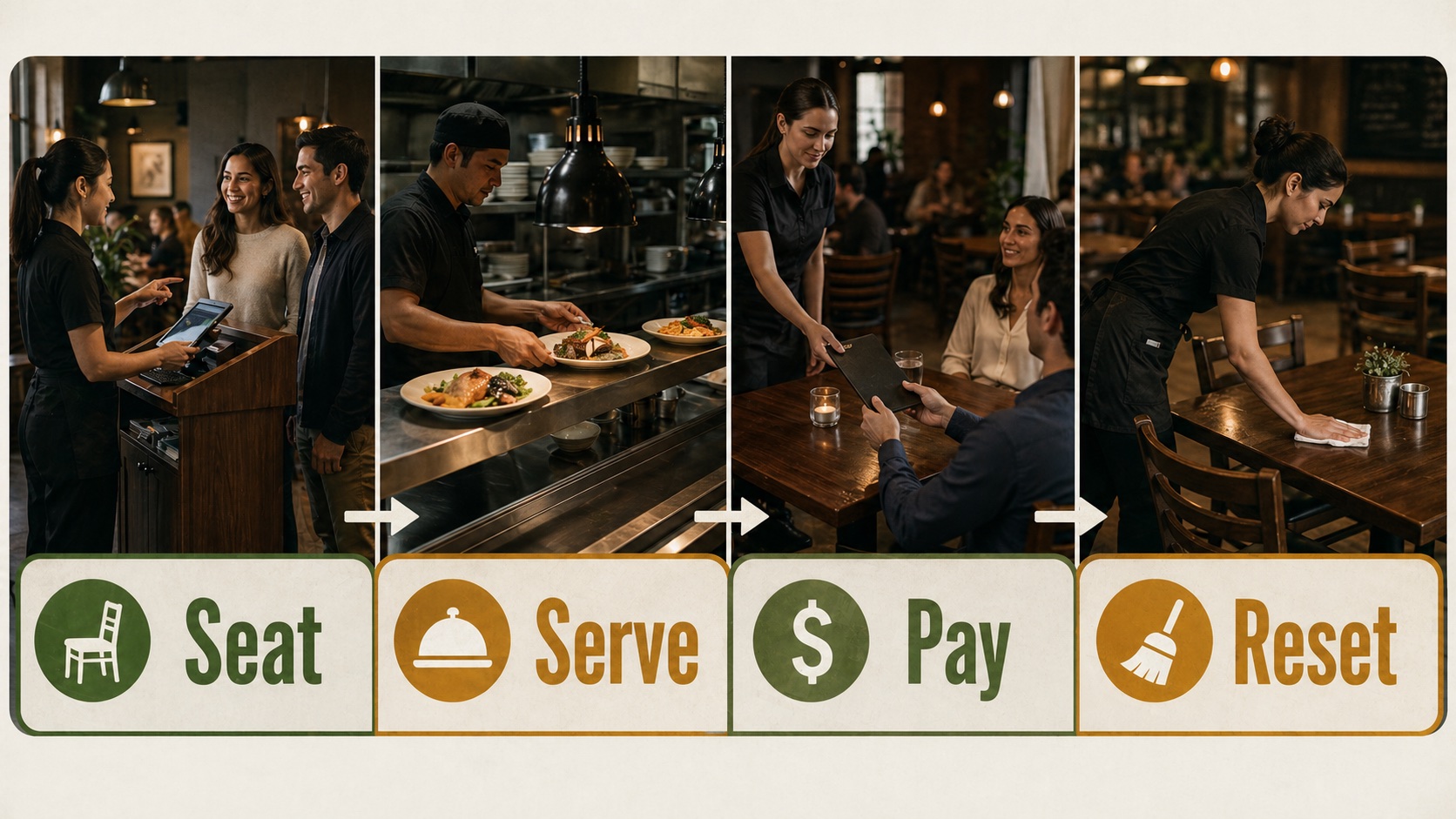
Common bottlenecks:
- Slow seating — Host stand delays, poor reservation flow
- Late drink orders — Server doesn’t greet within 2 minutes
- Long ticket times — Kitchen backup during rush
- Lingering after the check — No gentle nudge to close out
- Slow table reset — Bussing takes too long
Observe a few tables through the full cycle. Time each step. You’ll find the bottleneck fast.
How to Improve Table Turnover (Without Rushing Guests)
1. Greet Fast, Order Fast
The clock starts when guests sit. Every extra minute before the drink order costs you.
Target: Server greets within 90 seconds. Drink order taken within 3 minutes.
2. Streamline the Menu
A 3-page menu adds 5+ minutes of decision time. Keep it tight. Use visual hierarchy to guide choices.
Target: Menu should be scannable in 2 minutes.
3. Run Food Hot
Cold food means re-fires. Re-fires mean delays. Delays mean lost turns.
Target: Food to table within 2 minutes of kitchen completion.
4. Pre-bus Constantly
Don’t wait for the table to clear. Remove finished plates during service.
Target: Table cleared within 60 seconds of final bite.
5. Drop the Check Proactively
Don’t make guests wait 10 minutes to pay. Drop the check with dessert or coffee, or when the last plate clears.
Target: Check dropped within 2 minutes of dessert/coffee or “we’re all set.”
6. Reset Tables Faster
Have a standard reset protocol. Two-person reset is 2x faster than one.
Target: Table ready for next guest within 3 minutes of departure.
The Turnover vs. Experience Trade-off
Here’s the uncomfortable truth:
You can increase turnover and hurt your business.
Rushing guests leads to:
- Lower tips (servers push back)
- Bad reviews (“felt rushed”)
- Fewer repeat visits
The goal is efficient service, not fast exits.
Guests should feel attended to, not hurried. The difference is hospitality, not speed.
Tactical Example: Adding One Turn Per Night
Let’s say you run a 40-seat casual restaurant. Dinner is 5 hours. Average check is $35. Current turnover: 1.8 turns.
Current revenue:
40 seats × 1.8 turns × $35 = $2,520/nightIf you add 0.5 turns (to 2.3):
40 seats × 2.3 turns × $35 = $3,220/nightThat’s $700/night or about $21,000/month in extra revenue from the same seats.
How do you add 0.5 turns? Shave 10-15 minutes off average table time through better pacing.
Tracking Turnover in Practice
What to track:
- Parties served per period (lunch, dinner, day)
- Table count
- Average table time (seat to leave)
- RevPASH
How often:
- Daily: Parties served
- Weekly: Calculate turnover rate, RevPASH
- Monthly: Compare to previous month, spot trends
Tools:
- POS system reports (most can export covers per hour)
- Simple spreadsheet
- KitchenCost (connect menu costs to revenue targets)
Common Questions
Q: Should I time tables?
Yes, occasionally. Pick 3-5 tables during a busy shift. Track time from seat to check drop. Look for the bottleneck.
Q: Does reservation software help?
It can. Tools like Resy, Tock, or OpenTable let you set turn times by party size. But software won’t fix slow service — only better execution will.
Q: What if my concept is “hang out and stay”?
Then turnover isn’t your lever. Focus on check size, add-ons, and beverage sales instead.
This Week’s Action Items
- Calculate last week’s table turnover rate (parties ÷ tables)
- Time 3 tables from seat to departure
- Identify your biggest bottleneck (seating, ordering, kitchen, check, reset)
- Set a 2-week improvement target (e.g., shave 5 minutes off average turn)
- Track RevPASH weekly
Related Guides
Knowing your table turnover is step one. Knowing your menu margins is step two.
Try KitchenCost to connect your food costs to revenue per seat — free to start.
Method Notes
This guide uses durable restaurant operating formulas rather than current tax, labor, or inflation claims.
- Table turnover rate: parties served ÷ number of tables
- Seat turnover: guests served ÷ total seats
- RevPASH: total revenue ÷ available seat hours
- Benchmark ranges should be replaced with your own POS, reservation, and host-stand data once you have at least a few comparable weeks.