
Ice cream looks like a high-margin product until the shift gets busy.
One employee scoops heavy. A cone is treated as free. Toppings are included without a limit. A premium flavor uses more mix-ins than the base recipe. At the end of the week, the theoretical food cost still looks fine, but cash is thinner than expected.
The first move is not always a price increase. It is usually simpler: weigh the scoop before changing the price.
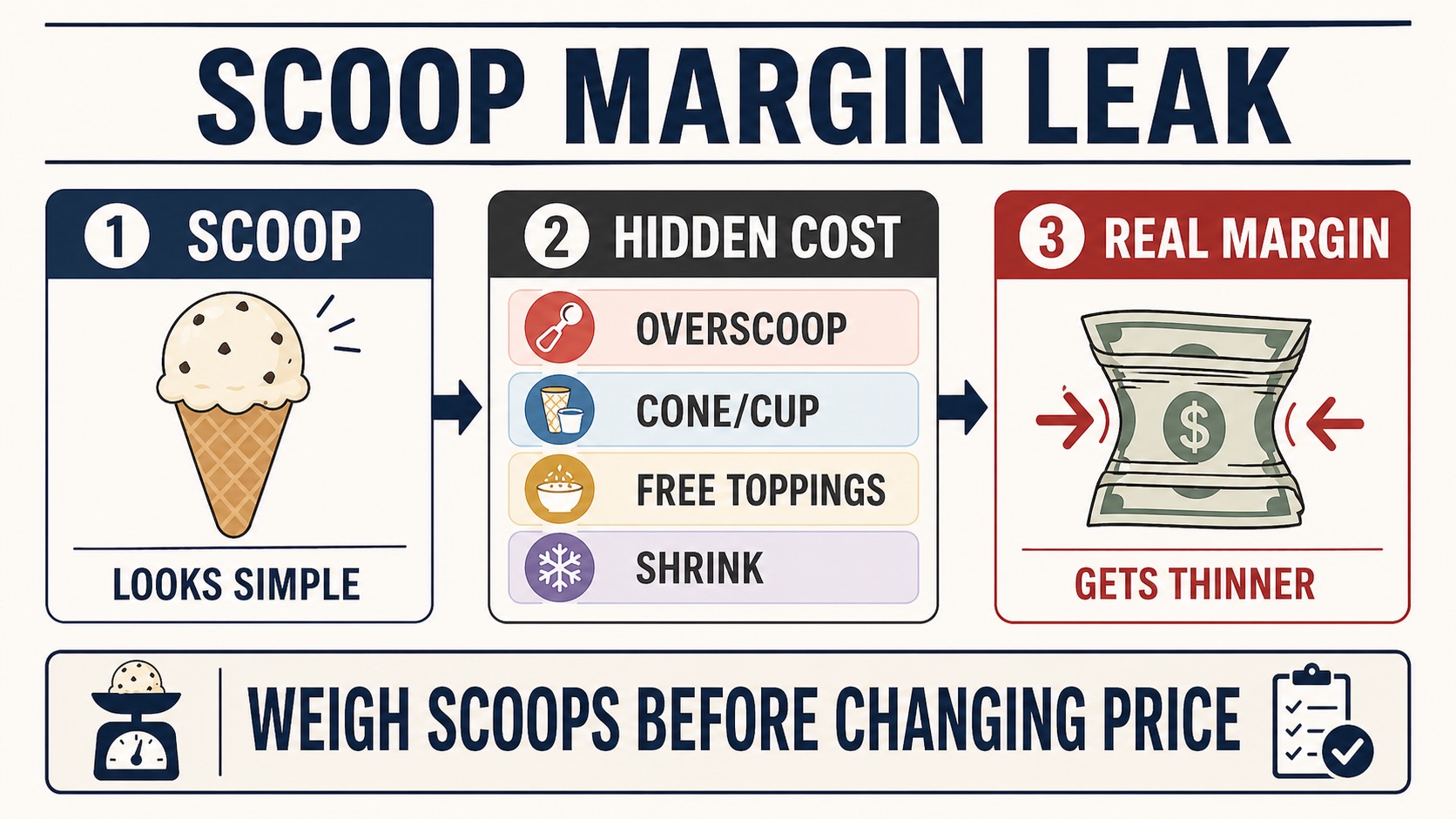
What Belongs in Scoop Cost
| Cost bucket | Examples | Why it matters |
|---|---|---|
| Base | Dairy mix, sugar, stabilizer, flavor base | Sets the cost per ounce |
| Overrun | Air added during freezing/churning | Changes drawn volume and ounce cost |
| Portion | Actual scoop weight | Busy shifts often run heavy |
| Mix-ins | Nuts, cookies, chocolate, fruit | Premium flavors can be a different product |
| Packaging | Cone, cup, spoon, napkin, lid | Real cost per order |
| Shrink | Melt, tasting, staff error, freezer loss | Needs allowance in pricing |
If those buckets are not separated, the shop will blame price when the real issue is portion control.
Core Formula
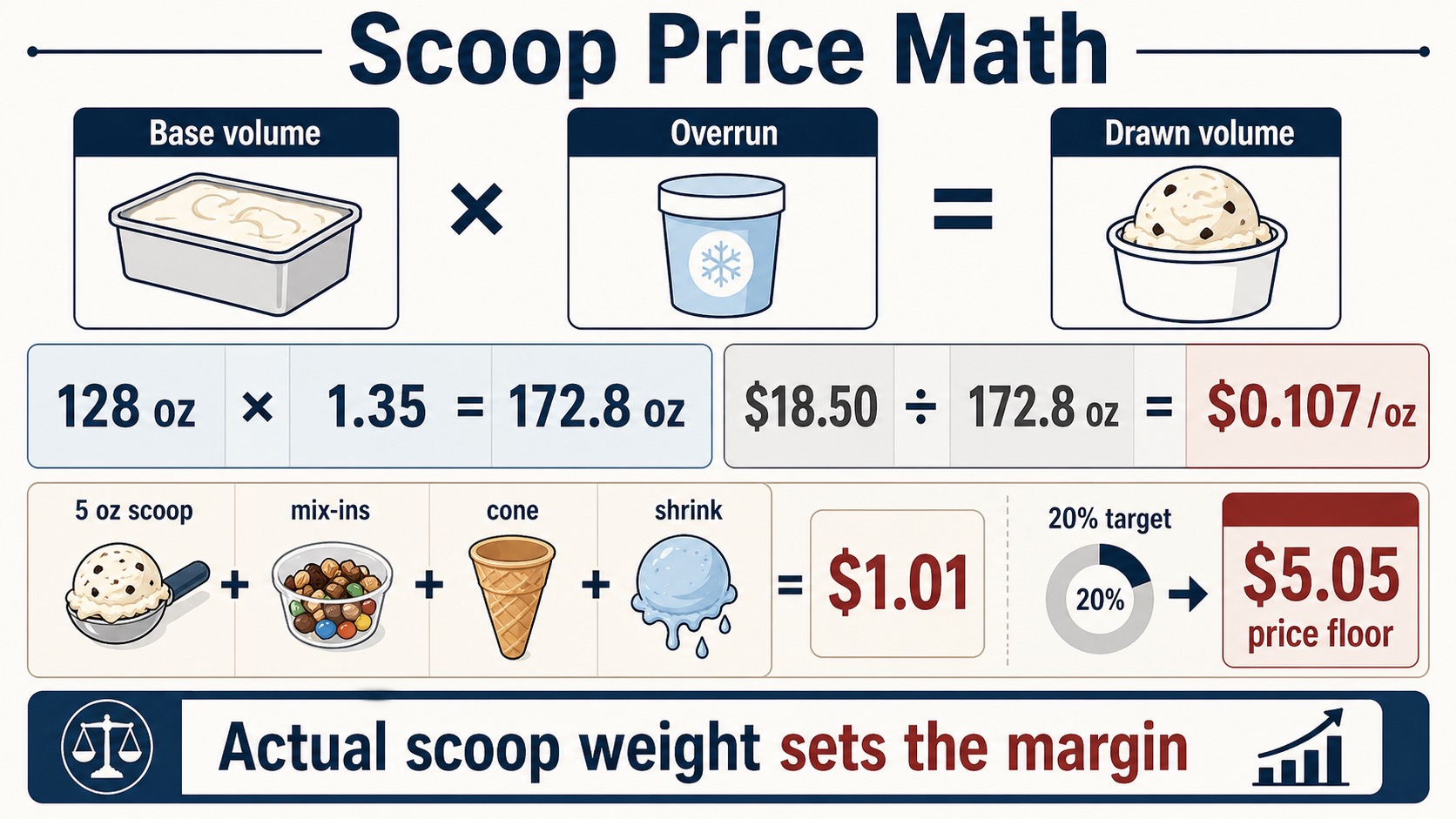
drawnVolume = baseVolume x (1 + overrunRate)

baseCostPerOz = baseMixCost / drawnVolume

servingCost = (baseCostPerOz x actualScoopOz) + mixIns + packaging

adjustedServingCost = servingCost / (1 - shrinkRate)

priceFloor = adjustedServingCost / targetCostRate
Worked Example: Single Scoop
Use this as the structure, then replace the values with your recipe and invoice costs.
| Input | Value |
|---|---|
| Base mix cost | $18.50/gallon |
| Base volume | 128 oz |
| Overrun | 35% |
| Drawn volume | 172.8 oz |
| Base cost per ounce | $0.107 |
| Actual scoop | 5 oz |
| Mix-in allowance | $0.22 |
| Cone + spoon | $0.17 |
| Shrink allowance | 8% |
Calculation:
servingCost = (0.107 x 5) + 0.22 + 0.17 = $0.93

adjustedServingCost = 0.93 / (1 - 0.08) = $1.01

priceFloor = 1.01 / 0.20 = $5.05
That supports a practical price lane around $4.99 to $5.49 depending on traffic, positioning, and local competition.
Where Frozen Dessert Margin Leaks
1. Overscooping
A 4 oz target scoop that becomes 5 oz is not a service detail. It is a 25% portion change. Weigh scoops at shift change, not only during training.
2. Cones and cups treated as free
A waffle cone, cup, spoon, napkin, lid, and bag should be attached to the format. A cone order and a cup order do not have the same cost.
3. Premium flavors priced like base flavors
Chocolate, nuts, cookies, fruit prep, and inclusions can turn one flavor into a different margin profile. Use a premium lane when the mix-in load is materially higher.
4. Free toppings with no limit
Sprinkles are different from nuts, candy, sauces, and fruit. If toppings are unlimited, the menu price must carry that behavior.
5. Shrink ignored during peak season
Melting, tasting, damaged cones, freezer issues, and unsold batches all need an allowance. Shrink is not a rounding error in a seasonal shop.
Format-Level Price Lanes
| Format | Watch item | Pricing move |
|---|---|---|
| Single scoop | Actual scoop weight | Set scoop standard and test weekly |
| Double scoop | Portion compounding | Make sure discount does not erase contribution |
| Waffle cone | Cone cost | Separate cone upcharge if needed |
| Sundae | Toppings and labor | Bundle only with measured toppings |
| Shake | Base volume and cup cost | Cost as a recipe, not as leftover ice cream |
KitchenCost can keep base recipes, flavor costs, portion standards, and packaging costs together, so a new flavor or size is not priced by memory.
20-Minute Weekly Margin Loop
| Step | Action |
|---|---|
| 1 | Update dairy and top mix-in invoice costs |
| 2 | Weigh actual scoops for top 10 flavors |
| 3 | Compare cone, cup, sundae, and shake contribution |
| 4 | Check shrink and tasting loss |
| 5 | Adjust one lever: scoop spec, topping rule, format price, or premium lane |
Operator Rule
Do not ask “Should we raise all prices?” first. Ask “Are our actual scoops the size we priced?”
Once the portion is real, the price decision becomes much cleaner.
Related Guides
Notes
- Cost examples are operating examples for frozen dessert pricing. Replace them with your recipe cost, overrun, actual scoop tests, and packaging costs.