

Start Here: What Owners Need to Check
- This guide is for restaurant owners evaluating Uber Eats Lite, Plus, Premium, pickup, and self-delivery by owner contribution.
- The first numbers to check are marketplace fee tier, food cost, packaging, labor, promos, pickup rules, and self-delivery labor or driver cost.
- Start with
Uber Eats contribution = order subtotal - merchant deductions - food cost - packaging - labor - promos - adjustments. - The examples below use a $40 marketplace order to show what the owner actually keeps.
- Today, split Uber Eats orders by marketplace, pickup, and self-delivery before using one menu price across all channels.
At a Glance: Uber Eats Merchant Fees by Channel
| Channel | Uber’s listed US pricing signal | Owner risk if you stop there | First owner check |
|---|---|---|---|
| Marketplace Lite | 20% Marketplace Fee | Lower fee can still lose money on low-AOV orders | Contribution by item, not order count |
| Marketplace Plus | 25% Marketplace Fee | More visibility can hide weaker retained dollars | Incremental contribution vs Lite |
| Marketplace Premium | 30% Marketplace Fee | High fee needs strong AOV or repeat behavior | Whether extra demand pays for the tier |
| Pickup | 7% with validated in-store pricing; 10% otherwise | Pickup economics change if pricing parity fails | Price validation status by location |
| Self-delivery | 15% platform fee | Your driver cost can erase the headline savings | Internal delivery cost per completed order |
| Webshop | 2.5% + $0.29/order | Low fee only matters if you can drive traffic | Repeat customer migration from marketplace |
| Uber Direct | From $7.99/order | Flat fee can be strong or weak depending on basket size | Order size and delivery zone economics |
The best path is not always the lowest listed fee. The best path is the one that leaves the most contribution after the full order stack.
The Better Metric: Contribution Per Uber Eats Order
Most owners start with commission rate because it is visible. That is understandable, but it is not enough.
Use this calculation instead:
Contribution per Uber Eats order =
  Order subtotal
  - Uber Eats platform deductions
  - Food cost
  - Packaging
  - Channel labor
  - Promo funding
  - Refunds, remakes, and adjustments
Then compare channels:
Weekly contribution by channel =
  Contribution per completed order x Completed weekly orders
If Uber Eats grows gross sales but lowers weekly contribution, it is acting like paid acquisition. That can be fine for a short test. It should not become your default margin structure.
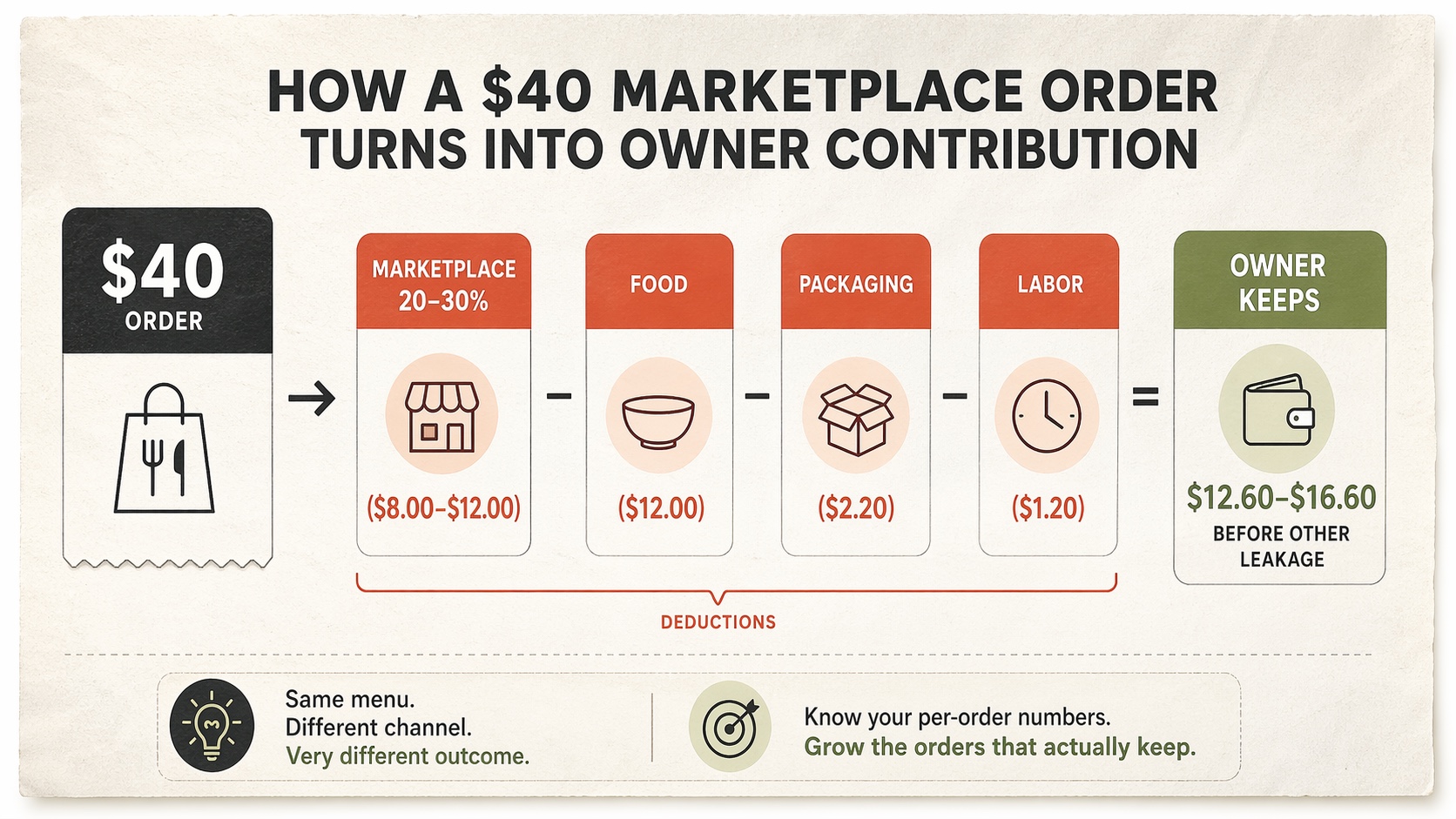
Example: $40 Marketplace Order
Assumptions:
- Order subtotal: $40.00
- Food cost: $12.00
- Packaging: $2.20
- Channel labor: $1.20
- Marketplace fee range: 20-30%
| Marketplace fee tier | Platform deduction | Net after platform | Owner contribution before other leakage |
|---|---|---|---|
| Lite: 20% | $8.00 | $32.00 | $16.60 |
| Plus: 25% | $10.00 | $30.00 | $14.60 |
| Premium: 30% | $12.00 | $28.00 | $12.60 |
That $4.00 spread matters. At 600 monthly marketplace orders, the difference between the 20% and 30% fee tiers is $2,400 before you count promo funding, remakes, ad spend, or refunds.
Marketplace Lite, Plus, or Premium: What to Decide
The wrong question is “which Uber Eats plan is best?”
The useful question is:
Does the higher fee tier create enough extra contribution dollars to pay for itself?Use this owner decision table:
| Signal in your statements | What it likely means | First action |
|---|---|---|
| Plus/Premium adds orders but not payout | Visibility is not converting into retained dollars | Test a lower tier for 14 days |
| Premium orders are mostly low-ticket | Fee pressure plus packaging is too high | Bundle or raise minimum viable price |
| Promos create volume but weak payout | Discount depth is eating the channel | Cap promos by item contribution |
| Repeat customers keep using marketplace | You are paying commission for demand you already own | Move repeat buyers to pickup/Webshop/direct |
| High-AOV items perform well | Marketplace may be worth keeping for those categories | Keep marketplace exposure on strong bundles |
Do not judge tiers by impressions or gross order count. Judge them by retained dollars per week.
Pickup: Lower Fee, But Only If Parity Works
Pickup can be one of the best Uber Eats paths for restaurant owners because the listed fee can be lower than marketplace delivery. But the 7% pricing is tied to validated in-store pricing.
That means pickup is not just an operational choice. It is also a pricing-control choice.
Check three things:
- Is your pickup pricing validated as in-store pricing?
- Are pickup customers buying high-contribution items?
- Are you using pickup to migrate repeat customers away from full marketplace delivery?
If pickup is validated and your menu architecture is clean, it can protect margin. If the same low-margin delivery menu is copied into pickup without review, you leave money on the table.
Self-Delivery: Lower Platform Fee, New Operating Cost
Self-delivery looks attractive because the listed platform fee is lower than marketplace delivery. But your own delivery cost is not free.
Add these costs before calling it cheaper:
| Cost | Why it matters |
|---|---|
| Driver labor | Paid time continues during slow routes and delays |
| Dispatch time | Someone still has to coordinate orders |
| Insurance and liability exposure | Risk shifts toward your operation |
| Failed delivery and remake cost | Service mistakes still hit the restaurant |
| Customer support time | Late or missing orders become your problem |
Self-delivery can work well for a tight delivery radius, strong repeat demand, and disciplined dispatch. It is risky when the team is already stretched and delivery is used as a patch for weak marketplace margins.
Webshop and Direct Ordering: Lower Fee, Higher Responsibility
Webshop pricing is much lighter than marketplace pricing, but it does not bring demand by itself.
That is the tradeoff:
- Marketplace buys discovery.
- Webshop protects margin.
- Pickup turns local repeat demand into lower-fee orders.
For a small restaurant, the practical move is not to quit marketplace overnight. It is to use marketplace for discovery and move repeat buyers toward pickup, Webshop, loyalty, email, SMS, or your own ordering link.
14-Day Uber Eats Owner Audit
Run this before changing tiers or adding another promotion.
- Export 30 days of Uber Eats statements.
- Group orders by marketplace, pickup, self-delivery, Webshop, and Direct.
- Calculate contribution per order for your top 10 items.
- Mark items below your minimum contribution target.
- Reprice, bundle, or remove weak delivery items.
- Compare Lite, Plus, and Premium by weekly contribution, not GMV.
- Move repeat buyers toward pickup or Webshop where possible.
- Repeat the review every month.
KitchenCost fits here when the calculation needs to become a habit. Put the ingredient cost, packaging cost, and target margin into the same place, then review top sellers whenever supplier prices or platform behavior changes.
Owner Decision Rule
Keep Uber Eats volume when it increases contribution dollars. Reprice or cap it when it only increases order count.
That is the difference between a delivery channel and a margin leak.
Related Guides
- Restaurant Delivery App Fees 2026: What Owners Keep
- Uber Eats Real Cost per Order: What Restaurants Lose
- DoorDash Real Take Rate: Why Your 30% Tier Costs 40%
- Same Prices for Delivery and Dine-In? Here’s the Loss